More and more people are discovering the fascination of researching their family history, but as genealogist Kate Sherry showed Hebden Bridge Local History Society, it is so much more than just filling in the gaps in a family tree. For Kate it took her to the heart of the textile industry, massively important for Lancashire in the 19th century and for Britain’s export trade.
In the 1850s, her 4x great grandfather, William Ingham, and his four sons, founded a cotton mill in Padiham, East Lancashire, known as Ingham & Sons. It sounds like a wealthy mill owning dynasty, but William’s origins were far from that stereotype, as the historical documents revealed. His father is recorded as a labourer, and William himself started as a labourer, though over time he took more skilled and responsible roles. The census of 1861 records a sudden change in fortunes: William is a cotton spinner employing nearly fifty men, women and children. There was obviously a story to be uncovered.
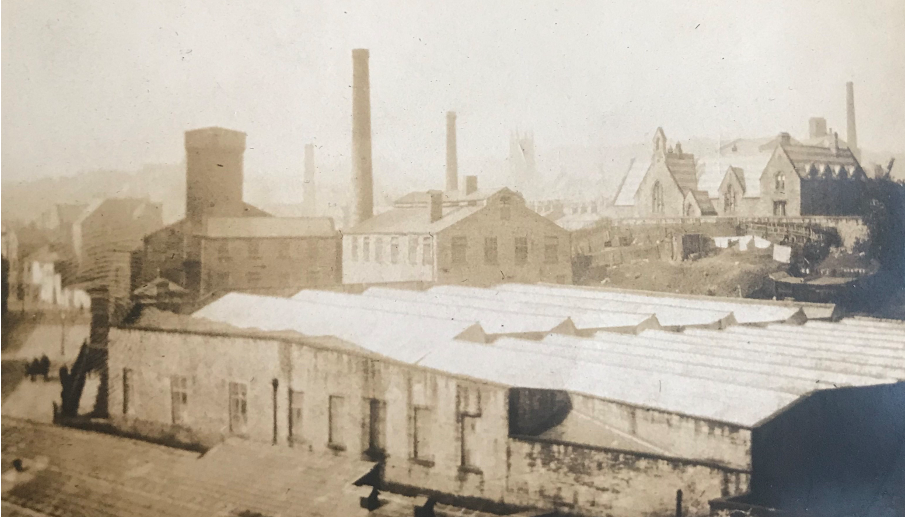
The answer lay in his marriage. Alice Helm came from a mill owning family, inheriting much of their wealth, and when she died, this passed to her sons. The Inghams built and equipped the Albert and Riverside mills and ran the business together. More significantly for a historian, the sons jointly kept a diary, recording work at the mill, and providing insights into personal, local and national events.
Trying to answer a question about family history led to a much wider understanding of how the textile industry was organised – making sense of all the different processes and understanding which jobs required more skill and experience. Records in the diary gave practical descriptions of the process of building the mills. They also revealed the pressures of working in this environment – the dust in the carding room; the high temperatures and humidity; the noise in the weaving sheds; and the excessive hours worked. Gradually, sometimes under the pressure of Union organised strikes, more legislation enforcing better conditions and especially the use of child labour came into effect.
Finding information in contemporary newspapers is far from a dry textbook study of social history. The records can be personal and raw. The historical world is full of real people who experienced the accidents, fires and strikes. We see conflicts between managers imposing rules and fines and the workers who felt the unfairness of financial penalties for minor faults. We see the growing ability of workers to organise, and the increasing need for governments to legislate.
What starts as family history opens a door to wider social history. We want to understand these people and the detail of their lives. It’s an enormous bonus to have access to a family diary, but there are many records available in archives and online.
Kate’s genealogy business is called Ancestor Trail. Hebden Bridge Local History Society has regular Family History coffee and cake mornings and discussion sessions. Details on the website www.hebdenbridgehistory.org.uk